CROP IMPROVEMENT DIVISION
1.1 Project Name: Development of broad-based high yielding varieties of diploid and tetraploid cotton through recurrent selection
PI : V.N. Waghmare
Importance of the study: This project involves several parental lines aimed at development of broad-based G.
arboreum and G. hirsutum varieties with improved fibre traits and high seed cotton yield through repeated cycles of selection and intercrossing. It also envisages development of high yielding spinnable as well as coarse type G. arboreum varieties and GMS-based hybrids for the North Zone.
Salient findings
Nagpur
Evaluation of advanced cultures: During 2023-24, 171 G. arboreum and 72 G. hirsutum selections were evaluated in 9 replicated trials (4 rows plots in 2 replications). Based on the data for economic performance and fibre quality traits, 107 advanced generation selections of G. arboreum were retained for further evaluation in replicated trial during 2024 25. The range for seed cotton yield among the G. arboreum selections ranged from 16.6 to 27.9 q/ha, boll weight: 2.2 3.28 g, GOT: 30.4-38.4%, fibre length: 25.2–29.9 mm, micronaire: 4.3–6.0, UI: 79.2-82.2 %, fibre strength:
24.3-34.1 g/tex and fibre elongation: 5.4-6.3%. Similarly, for G. hirsutum, 38 advanced selections were retained for further evaluation. The ranges for various economic and fibre quality trait values among the upland cotton selections ranged; 2.6 -3.8 g for boll weight, 29.7 – 44.4% for GOT, 10.93 – 21.64 q/ha for seed cotton yield, 27.2- 32.9 mm for fibre length, 2.4-3.9 for micronaire, 80.7- 83.5 % UI, 26.5-36.5 for fibre strength and 5.3-6.2% for fibre elongation.
Evaluation of single plant selections: We evaluated 542 fertile single plant selections (347 of G. arboreum and 195 of G. hirsutum) as plant- to- row progenies. Superior single plants (604 Nos.) from the segregating progenies (117 of G. arboreum and 487 of G. hirsutum) were identified and harvested separately for further evaluation. Based on the performance and uniformity of advanced-generation plant progenies, 24 plant progenies of G. arboreum and 31 of G. hirsutum were identified for evaluation in replicated trial during 2024-25.
Evaluation of sterile plants: Sterile single plant progenies (673 nos) of G. hirsutum were planted as plant to row progenies. Trait-specific populations and sterile plant progenies were monitored for sterile and fertile plants at flowering and tagged. In sterile plant progenies, observations of economic traits were recorded on 3 fertile random plants of each progeny. Based on superiority for specific traits, namely boll weight, GOT, seed cotton yield and fibre traits, about 10- 15% superior progenies were identified to constitute trait-specific population and to further advance the recurrent selection cycle.
Recurrent populations: Composite populations in G. hirsutum were constituted for boll wt., GOT and SCY and fibre quality traits and were and grown on large plots. Thus, two recurrent selection cycles were completed in G. hirsutum during 2023-24. In G. arboreum, trait-specific composite populations were monitored for sterile and fertile plants at flowering and tagged. Individual sterile plants from the 4 trait- specific composite populations (about 500 each) were harvested separately for evaluation and advancement of the recurrent selection cycle. From the 4 composite populations, 266 promising fertile plants were selected for evaluation as plant to row progenies.
Evaluation of BLB selections: We evaluated 79 advanced single-plant selections in two unreplicated row plots. Of these, 21 progenies were still segregating for resistance or susceptibility to BLB. About 24 uniform and BLB- resistant progenies with better fibre quality traits were identified for yield performance evaluation during 2024-25.
Entries promoted under AICRP trials: G. arboreum entry CNA 1085 was promoted to AVT II in the Central Zone, and entries i.e., CNA 1084 and CNA 1085 were promoted to Br. 24(a/b) AVT II in the South Zone.
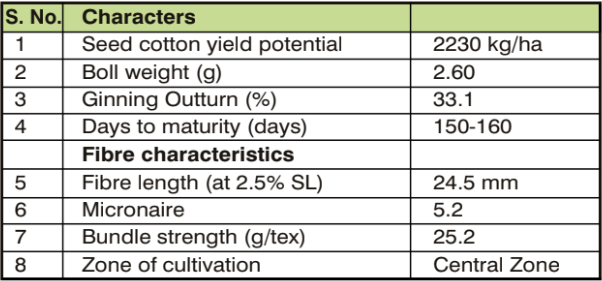
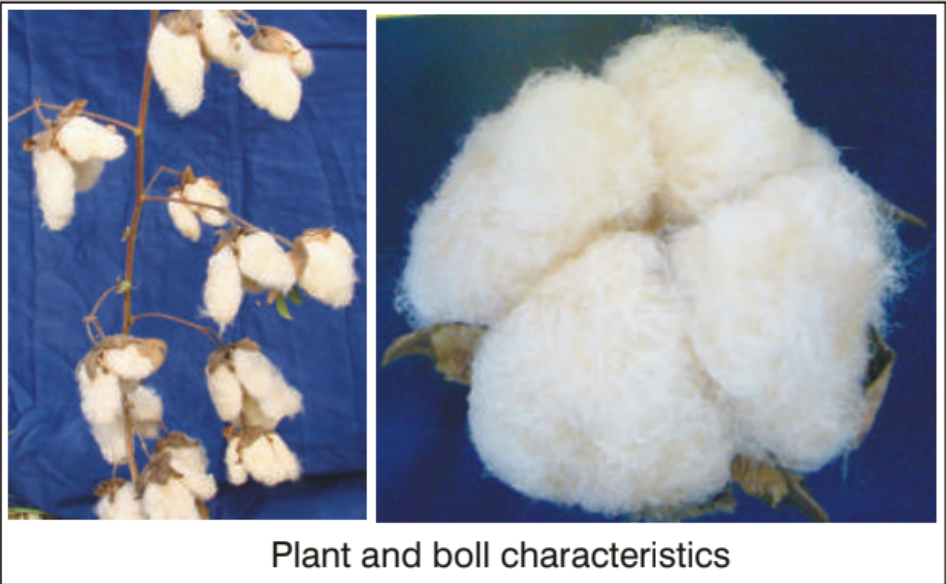
Agronomy Trial: The genotypes CNA1092 and CNA 2034 of G. arboreum were evaluated in an agronomy trial in the Central and South Zones, respectively, under rainfed conditions. A variety identification proposal of CNA 1092 was submitted to the ICAR-AICRP on cotton. CNA 1092 was identified by the Varietal Identification Committee and subsequently released by CVRC vide Gazette Notification S.O. 4388(E) dated October 08, 2024.
Table 1.1.1: Yield and fibre quality parameters CNA 1092
Maintenance and multiplication of varieties: CNA1028, CNA1032, CNA1031, CNA1054, CNA1003, CNA1091, CNH1111, and CNH1128. In the previous year, 180–200 single plants were selected from each variety and evaluated for economic and fibre quality traits during 2023–24. About 5–10% progenies matching the varietal traits were identified and bulked to constitute nucleus seeds for each variety.
Sirsa
Evaluation of GMS-based G. arboreum Hybrids: Five GMS-based hybrids were evaluated for seed cotton yield using check CICR 2 and zonal check KR 64. Two GMS-based hybrids i.e. CISAA 23-3 (3072 kg/ha) and CISAA 23-2 (2952 kg/ha) recorded significantly higher seed cotton yields than hybrid CICR 2 (2601 kg/ha).
Evaluation of High-yielding G. arboreum genotypes: Sixteen varietal cultures were evaluated using the RBD design, including two check varieties, CICR 1 (CISA 310) and CICR 3 (CISA 614). Two elite lines i.e. CISA 8-1 (2846 kg/ha) and CISA 6-11 (2773 kg/ha) recorded significantly higher seed cotton yield than high-yielding best check CICR 3 (2206 kg/ha).
Evaluation of spinnable G. arboreum genotypes: Twelve spinnable cultures were evaluated in the RBD design including two check varieties, CISA 310 and CISA 614. Two elite lines i.e. CISA 10 (2241 kg/ha) and CISA 33-2 (2197 kg/ha) recorded significantly higher seed cotton yield than the quality check PA 255 (1522 kg/ha) and numerically higher seed cotton yield than the high-yielding best check CISA 614 (2170 kg/ha). In a separate trial, 20 spinnable cultures were evaluated. Four cultures, namely NA-5 (1966 kg/ha), NA-2 (1755.8 kg/ha), NA-9 (1734 kg/ha), and NA-12 (1694.8 kg/ha) recorded significantly higher seed cotton yield than quality check PA 255 (1472 kg/ha).
Maintenance, advancement, and selection: Four GMS lines DS 5, CISA 2, GAK 413A, CISG 20, and 03 newly developed GMS lines, CISG-10, CISG-13, CISG-14 and 9 combiner lines of G. arboreum were also maintained. G. arboreum selections with better spinnability (23–26 mm fibre length) were advanced.
Entries under AICRP (North Zone): One GMS-based G. arboreum intra-arboreum hybrid CISAA 19-4 was promoted to the Agronomy Trial. Two GMS-based G. arboreum intra-arboreum hybrids i.e., CISAA 22-1 and CISAA 22-3 were promoted under Coordinated trial Br 25a. Two G. arboreum varieties i.e., CISA 8-1 and CISA 6-11 were sponsored in Br 22a/b National trial. Two intra-arboreum hybrids i.e., CISAA 23-2 and CISAA 23-3 were sponsored in the Br 25a/b (National trial).
1.2 Project Name: Collection, conservation, evaluation, documentation and maintenance of germplasm of cultivated species of Gossypium.
PIs: Vinita Gotmare
Co-PIs: Sunil S. Mahajan, M. Saravanan, Neelakanth S. Hiremani, Manickam, A.H. Prakash, A. Manivannan, Debashis Paul, Anjali Kak
Importance of the study: The mandate of the institute is collection, conservation, evaluation, exchange, documentation of cotton germplasm in Medium-Term Storage (MTS) to ensure their availability and utilization to the public and private sector breeders and researchers of the country.
Salient findings: Conserved 12,386 accessions including cultivated and wild species of Gossypium perennials, landrace interspecific derivatives, and 52 registered genetic stocks. One exotic germplasm was imported from Nepal. A total of 5187 germplasm accessions were evaluated in 2023–24 (780 core collection at both locations Nagpur and Sirsa) while G. barbadense (205) at ICAR-CICR RS Coimbatore for morphological and biotic stress. At Sirsa, IC359084, IC358473, IC359143, IC359758, IC359238, EC700049, IC357745, IC356611, and EC700514 were identified for higher seed cotton yield attributes.
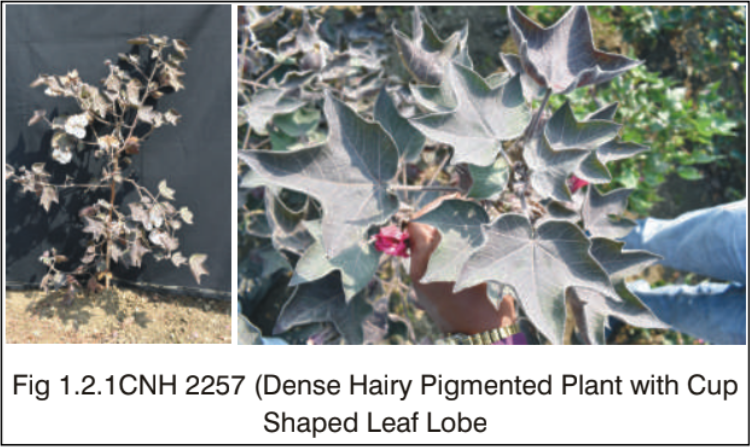
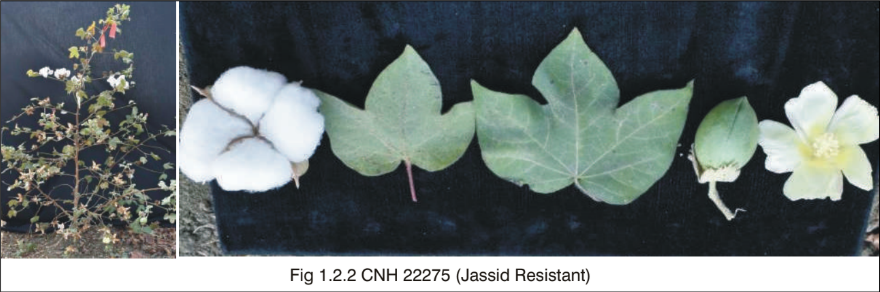
Three new genotypes [G. arboreum race Cernuum (2) and G. barbadense (1)] were collected through survey and exploration in the West Garo Hills of Meghalaya. CMS conversion of the three identified male sterile lines was performed, and leaf curl viral disease resistant lines (BC3F1) were developed in Nagpur and evaluated at the hot spot ICAR-CICR, RS, Sirsa. BC3F1 backcrosses for water-logging tolerance were developed and field evaluated. A germplasm field day was conducted for breeders of SAUs on 5th January 2024 and for SAUs and private seed company breeders on 19th January 2024. At least 231 germplasm accessions, as indented, were shared with breeders of SAUs; 86 accessions were deposited in MTS and an additional 283 accessions were processed for sharing with SAUs. Two G. hirsutum single plant progenies, namely CNH 2257 (dense hairy pigmented plant with cup-shaped lobed leaf – Figure 1.2.1) and CNH 22275 (jassids resistant – Figure 1.2.2), have been identified for registration as unique genetic stocks.
1.3 Project Name: Genetic diversity and utilization of wild germplasm for cotton improvement.
PI: Vinita Gotmare
Co-PI(s): M. Saravanan, Rachna Pande, Neelkanth Hiremani, Annie Sheeba, Sampath Kumar, K. Baghyalakshmi & Subhash Chandra
Importance of the study: Wild species are reservoirs of many useful genes governing different economic traits, including lint yield, fibre quality, and resistance to biotic and abiotic stresses. In view of the narrow genetic base of cultivated cotton, the available wild species, including newly introduced tetraploids, races of cultivated species, and synthetic polyploids of Gossypium, are conserved and utilized in introgression breeding to broaden the genetic base and improve cultivated species.
Salient findings
Nagpur
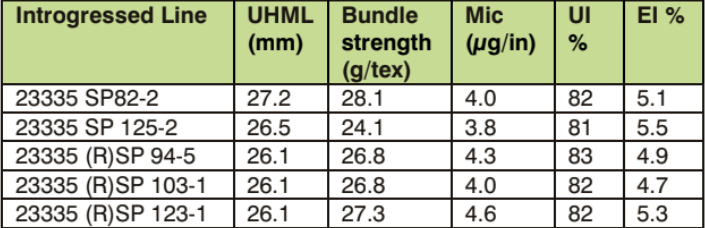
More than 425 introgressed derivatives were evaluated for fibre traits, biotic and abiotic stress tolerance. A total of 32 wild species, 15 races of cultivated species, and more than 45 synthetic polyploids were conserved in the wild species garden. Twenty-one accessions of nine exotic wild species imported from USDA in 2021 were established. The seeds of two wild tetraploid species, G. mustelinum and G. ekmanianum, were harvested. A total of 2340 crosses using wild species namely G. australe, G. thurberi, G. raimondii, G. barbosanum, G. anomalum, G. capitis virides, G. triphyllum, G. klotzchianum, G. longicalyx, G. somalense, G. mexicanum, G. incanum, G. mustelinum, G. ekmanianum, G. aridum, and Thespesia lumpas were attempted with cultivated species, while 314 crosses were harvested. The F6 generation was advanced to F7 generation for field evaluation, and a total of 180 single plants were selected on the basis of yield and yield contributing characters in wild derivatives viz., G. arboreum × G. longicalyx, G. arboreum race indicum × G. davidsonii, G. arboreum × G. thurberi, and AK 8401 × G. davidsonii for fibre fineness and elongation. Five lines (Table 1.3.1) have been identified and selected for registration as Genetic Stocks (G. arboreum × G. longicalyx), namely 23335 SP82-2, 23335 SP 125-2, 23335 (R) SP 94-5, 23335 (R) SP 103-1 and 23335 (R) SP. 123-1. More than 50 naturally colour cotton genotypes have been evaluated for fibre and other economic traits and one green linted genotype has been selected for further evaluation.
Table 1.3.1: Five introgressed lines selected for registration as Genetic Stocks (G. arboreum x G. longicalyx, F7)
Sirsa
During 2023–24, four BC3F1 populations with cultivated genotypes (CSH 3129/CSH 3075/HS 6) as recurrent parents involving GVS 8 and GVS 9 were evaluated for yield per plant, insect-pest reactions and CLCuD resistance, wherein high-yielding CLCuD-resistant segregants (N = 07; PDI = 0) were identified. Six BC3F1 populations with unadapted genotypes (GVS 8/9) as recurrent parents involving cultivated genotypes were evaluated for yield per plant, insect-pest reaction and CLCuD resistance, wherein high-yielding CLCuD-resistant segregants (N = 22; PDI = 0) were identified at ICAR-CICR, RS, Sirsa.
1.4 Project Name: Development of Bt hybrids in tetraploid cotton with high yield, superior fibre quality and tolerance to jassids.
PI: M. M. Saravanan
Co-PIs: Rahul M. Phuke, Amudha J, Prabhulinga T
Importance of the study: The aim of this study is to develop elite Bt cotton hybrids with superior fibre quality traits and tolerance to jassids. To break yield barriers, hybridization involving genetically diverse parents is the most important method. The yield advantage is generally higher in hybrids compared with varieties.
Salient findings
BG (II) advanced lines, jassid-tolerant lines (CNH2, CNH8 & CNH14) and ICAR-CICR released varieties such as Suraj Bt, PKV081 Bt, Rajat Bt, GJHV374 Bt and CICR21 Bt were used as male parents. Varieties such as Suraksha, Suchitra, Sunantha, PKV081 Non-Bt, Suraj Non-Bt and genetic stocks such as CNH204710 (above 40% ginning outturn) and big boll germplasm accessions such as IC356655, IC359922, IC357255, IC359721, IC359084, IC356720, IC359266 and IC357449 (>5 grams) were utilized as female parents in the crossing programme.
A Line × Tester mating design was followed and all 98 F1s were evaluated in a randomized block design (RBD) with two replications. The F1 hybrids were compared with parental lines and three check hybrids for estimation of general combining ability (GCA), specific combining ability (SCA) and heterosis. Three crosses, namely IC356655 × PKV081 Bt, IC204710 × CICR 21 Bt and IC357255 × 503, performed better than the best performing parental line (CICR 21 Bt). Jassid screening of parents and F1 hybrids was carried out at 30, 60 and 90 DAS.
1.5 Project Name: Screening of germplasm and induced mutagenesis for the development of herbicide-resistant cotton.
PI: M. Saravanan
Importance of the study: This study aimed to screen G. hirsutum germplasm and induced mutagenesis for developing herbicide-resistant cotton. Herbicide-resistant cotton enables efficient weed management and maximizes cotton productivity.
Salient findings
Screening of 7240 G. hirsutum lines, including 20 most tolerant and 20 most susceptible lines, for glyphosate resistance/tolerance was carried out under field conditions during Kharif 2023–24. Glyphosate @100 ml/15 litres of water was sprayed 48 days after sowing and observations were recorded up to 14 days after spray for symptoms such as chlorosis, wilting, growth response and stunting. Based on observations, 39 most tolerant lines (Nos. 5, 22, 25, 27, 31, 36, 101, 103, 104, 118, 165, 237, 250, 256, 265, 267, 280, 285, 290, 294, 295, 297, 298, 300, 301, 302, 310, 455, 557, 3561, 3749, 3913, 4000, 4039, 4073, 4080, 4086, 4110 and 4199) and 20 most susceptible lines (80, 87, 163, 170, 325, 490, 515, 565, 575, 594, 3507, 3527, 3537, 3578, 3693, 4176, 4296, 4326, 4403 and 4419) were identified for future research programmes. The M2 population of gamma-irradiated (200 & 300 Gy) Suraj Non-Bt cotton was established and screened against glyphosate during Kharif 2023–24. Glyphosate @100 ml/15 litres of water was sprayed 48 days after sowing and observations were recorded up to 14 days after spray as described above. Based on symptoms, 16 most tolerant lines were identified for further studies.
1.6 Project Name: Advancement of MAGIC population to develop core set for genetic mapping and identification of potential inbred lines.
PI: Rahul M. Phuke
Co-PI: Y. G. Prasad
Importance of the study: MAGIC populations, due to their complex pedigree structure, offer great potential for improving breeding populations and provide better chances to break negative linkage between yield and fibre quality traits. MAGIC populations possess richer diversity and higher recombination rates without population structure, enabling genetic dissection of complex traits to support modern plant breeding programmes.
Salient findings
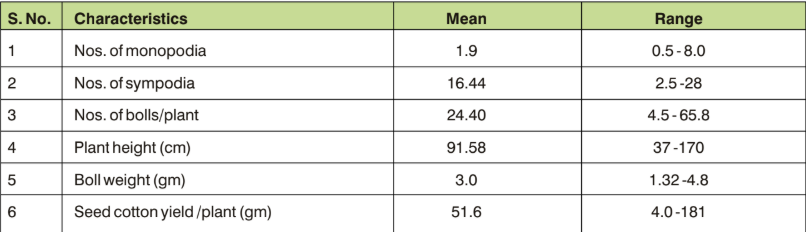
A total of 2,886 MAGIC lines at the F6 stage were sown in a single row of eight dibbles using an augmented design, with parents included as checks. Selfing was performed on 4–5 flowers from a randomly selected plant in each line. Data were collected on plant phenology traits including plant height, number of bolls per plant, number of monopodia, number of sympodia, boll weight, seed cotton yield (SCY) per plant, jassid grade, maturity score, compactness score and boll shape. The variations observed in traits are summarized in Table 1.6.1. Out of the total lines, 336 exhibited segregation and were removed from the panel. A total of 106 lines were identified as promising, among which 81 showed SCY per plant greater than 100 grams.
Table 1.6.1. Observed variation for studied traits in 2731 MAGIC RILs